Monday, July 7, 2014

Battling Biometrics required for Oklahoma Driver's Licenses

Woman battles against biometrics required for Oklahoma driver’s licenses
Posted By Patrick B. McGuigan On June 19, 2014 @ 11:47 am
By Patrick B. McGuigan | Oklahoma Watchdog
OKLAHOMA CITY — A national organization with a history of battling for civic liberties has joined Oklahoman Kaye Beach in litigation against the state Department of Public Safety’s requirements for mandatory biometrics to secure driver’s licenses.
.[1]
FREEDOM FIGHTER: Kaye Beach of Norman, Oklahoma has multiple reasons she is opposed to government collecting and relating “biometric” information before issuing drivers’ licenses. This week, the Rutherford Institute took her side in district court litigation.
Beach doesn’t like the requirement that residents must get their picture and fingerprints taken for a license to drive. The Charlottesville, Va.-based Rutherford Institute [2] announced Wednesday it was taking up the case.
“I filed a lawsuit against this policy in the first place because I believe it is a violation of my right to freedom of religion, as well as my right to be free from unreasonable search and seizure, both of which are protected under Oklahoma law,” Beach told Oklahoma Watchdog.
Beach said her concerns began a decade ago, when she was required to provide fingerprints to get a license.
She said she studied “more about technology and policies being implemented. I was bothered by the fingerprints, and then came the facial recognition.”
The latter is a reference to new photo technology applied to state licenses in recent years.
“I am opposed to this on a number of levels,” Beach said. “I believe it is contrary to my right of privacy, with the government’s growing ability to track us. I contend it violates the First and Fourth Amendments, and possibly the Tenth Amendment.”
Rutherford President John W. Whitehead said in a press release that Oklahoma’s practice represents “the long arm of Big Brother” and “ultimate control by the government.”
“As Kaye Beach’s case makes clear, failing to have a biometric card can render you a non-person for all intents and purposes, with your ability to work, travel, buy, sell, access health care, and so on jeopardized,” Rutherford said.
Beach fears such information stored by the government can be stolen.
“Bottom line, there is no such thing as a secure database. If the information exists, it will be hacked and it will be used and misused,” she said.
Beach’s passion in the matter is personal, not rhetorical — she still does not have a driver’s license.
You can view the case in Cleveland County District Court here. [3]
You may contact Pat at pmcguigan@watchdog.org [4] .

Article printed from Watchdog.org: http://watchdog.org
URLs in this post:
[2] The Charlottesville, Va.-based Rutherford Institute: https://www.rutherford.org/%20
[3] You can view the case in Cleveland County District Court here.: https://www.rutherford.org/files_images/general/6-18-14_Beach_Motion3.pdf),%20

Oklahoma City Mayor Mick Cornett discusses repealing Common Core at Dallas conference


Oklahoma City Mayor Mick Cornett discusses repealing Common Core at Dallas conference
Cornett was one of five mayors on a panel moderated by Michael Hancock, mayor of Denver and chairman of a U.S. Conference of Mayors education excellence task force.

The 14 Most F#$%ed Up Things About America's Obsession With Putting People Behind Bars


Posted:   |  Updated: 06/16/2014 11:59 am EDT
If being in prison were an occupation, it would be one of the most common jobs in the country. Yup, the U.S. is the world's superpower of incarceration: This country puts more of its citizens behind bars than any other nation. In fact, most states spend more money incarcerating prisoners than educating students. But it wasn't always that way. How did we turn into a nation that addresses its social ills by locking its citizens behind bars... and sometimes throwing away the key? Here's the breakdown of some of the most f#$%ed up things about America's prison obsession.
1. The total prison population has grown by 500 percent over the last 30 years.
The grand result? More than one out of 100 American adults is behind bars (about 2.3 million people, by the end of 2012) -- while a stunning one out of 35 American adults are imprisoned or under probation or parole supervision. That's a total of about 6.94 million people in the U.S. adult correctional systems, and police made nearly double that number of total arrests in 2012. 


2. One of the biggest reasons for this spike? There are 12 times more drug offenders in state prisons than there were in 1980.
Drug offenders now make up nearly half of federal inmates and nearly 17 percent of state inmates. As of 2011, there were about half a million Americans serving time for drug offenses, most frequently on low to middle-tier trafficking or possession charges.
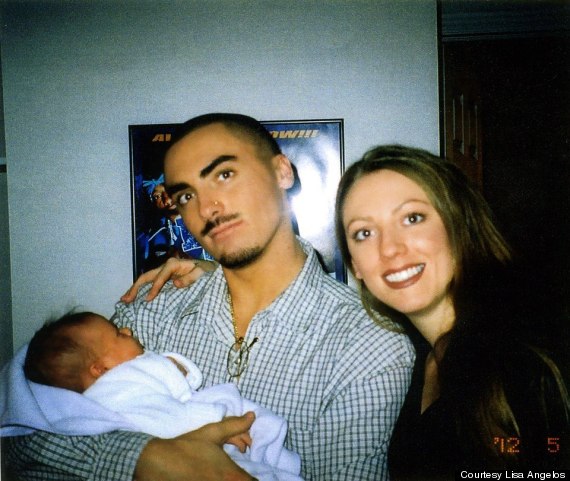
Under legal changes like the Rockefeller laws, mandatory sentencing and three-strike rules, America began sentencing thousands of low-income drugs users to decades in prison. These drug crimes don't frequently overlap with homicides: In 2007, FBI reports indicated that 3.9 percent of murders were directly linked to narcotics. What's more, nonviolent crimes are not typically deterred by tougher sentencing laws. While there's a push to lessen the sentences for federal and state drug offenders, many continue to serve the strict sentences of yesteryear. Weldon Angelos of California is just one such example:
weldon angelos
In 2003, Weldon Angelos was sentenced to 55 years without parole for selling marijuana, allegedly while carrying a gun. Even the judge who handed down the mandatory sentence called the punishment "unjust, cruel and even irrational," and urged then-President George W. Bush to pardon Angelos. He remains in prison.


3. We lock people up for life like it's not someone's life.
lifeparole
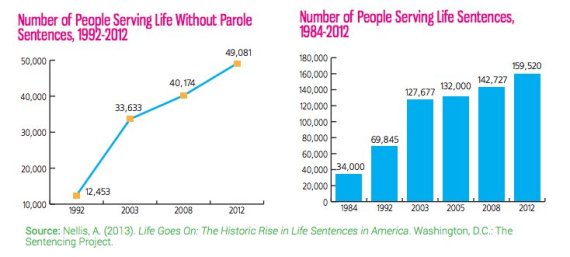
Source: The Sentencing Project 2013 report, "Life Goes On: The Historic Rise In Life Sentences In America."
Life behind bars was once reserved for the most dangerous murderers, for whom rehabilitation did not seem an option. With 159,520 behind bars for life as of 2012, we hand out such sentences with astonishing frequency, and for a wide range of crimes. In 2013,10,000 Americans were spending their lives in jail for non-violent crimes. Increasingly, these life sentences come without the possibility of being released on parole. For instance, Jeff Mizanskey is just one of many Americans serving life in prison without parole for non-violent drug crimes.
lifeeiwthout
Jeff Mizanskey was sentenced to life-in-prison without the possibility of parole in 1993 under Missouri's "three-strikes" mandatory sentencing policy. All three of his convictions involved non-violent distribution of small amounts of marijuana. His son is petitioning the Missouri governor to grant his father clemency.


4. Currently, one-third of the world'sentire imprisoned female population is awaiting trial or serving sentences in the U.S., mostly for nonviolent crimesMany are mothers.
The rate of female incarceration is increasing at a rate nearly double that of male incarceration. Notably, 85-90 percent of female inmates have a history of domestic and sexual abuse, while nearly three-quarters of women in state prisons have mental health problems. These numbers are particularly disturbing when you consider what women face in prison: high rates of PTSD and adisproportionate rate of sexual assault, very often at the hands of prison staff.
Though the Prison Rape Elimination Act was passed more than a decade ago, only two states are currently in full compliance with the law, and anumber of GOP governors across the U.S. have actually fought federal efforts to combat this epidemic, which affects both male and female prisoners at high rates.


5. We lock up more juveniles than any other developed country.
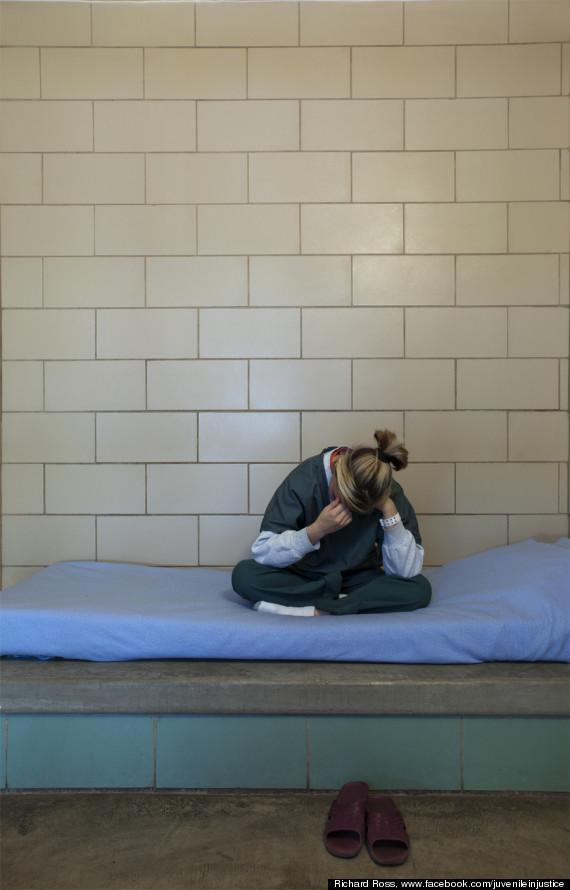
Of the youths under correctional supervision, 40 percent live in "correctional facilities" under prison-like conditions.
juvenile prison
Source:Richard Ross, www.facebook.com/juvenileinjustice
Research indicates that two-thirds of those juveniles suffer from mental health problems. According to anational survey from 2010, more than two-thirds suffer from substance abuse problems, while seven out of 10 had seen someone killed or severely injured and three out of 10 had attempted suicide. While locked up, many juveniles suffering from these conditions did not receive mental health counseling or substance abuse treatment. Meanwhile, 42 percent live in fear of being physically attacked and 30 percent reported being physically and/or sexually abused. Almost a third say solitary confinement is used as punishment at their facilities. Meanwhile, juvenile inmates lack the educational resources to get prepared for a normal life upon release.


6. And we're one of the only countries that treats some juvenile offenders like adults.
An estimated 10,000 juveniles are housed in adult prisons and jails every day. Children of color are disproportionately incarcerated in these facilities. Juveniles held in adult confinement are twice as likely to be violently attacked in prison, more likely to commit suicide and more likely to commit future crimes once released.
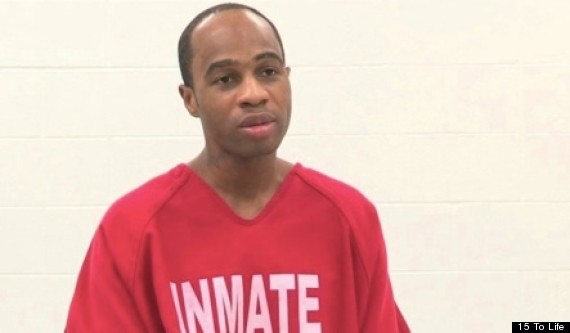
Today, an estimated 2,570 Americans are serving life sentences for crimes committed as juveniles. These crimes are typically committed in group scenarios, often under the direction of an adult. Black juveniles were far more likely to be sentenced to life in prison. It's some consolation that a recent Supreme Court decision discouraged future life sentences for juveniles. That led to the resentencing of some juvenile offenders, such as Kenneth Young.
kenneth young
Kenneth Young was 14 years old when he committed four armed robberies along with his mother's 24-year-old drug dealer in Florida. He received four consecutive sentences of life in adult prison without parole; the 24-year-old received one life sentence without parole. A change in state law gave Young a chance at resentencing, after which his sentence was reduced to 30 years in prison. His story inspired a recently released documentary, 15 To Life.


7. Racism permeates the system: More than 60 percent of those imprisoned are people of color, though they constitute only 30 percent of the total U.S. population.
To put that in perspective, there are currently more black men held within the criminal justice system (prison, jail, parole, probation) than were enslaved at the outbreak of the American Civil War. Much of this is a byproduct of racism in the war on drugs: Black Americans were nearly four times more likely to be arrested for possessing marijuana than white Americans -- even though white Americans were just as likely to use marijuana. Similar overall discrepancies occur for the youth population: Black youths are five times more likely to be incarcerated than white youths, while Latino and American Indian youths are two to three times more likely.
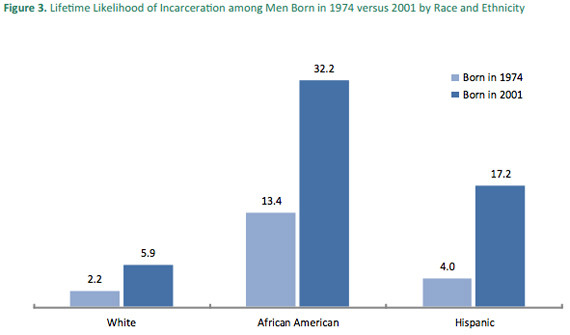
A 2003 Bureau of Justice report estimated that at current rates, black men born in 2001 have a 32.2 percent lifetime likelihood of incarceration -- in other words, one in three black men is likely to end up in prison. Meanwhile, some research indicated that black men serve between 14 and 20 percent longer prison terms than white men for the same crimes.

incarceration
Source: "Imprisonment and Disenfranchisement of Disconnected Low-Income Men" from Race, Place, and Poverty: An Urban Ethnographers' Symposium on Low-Income Men, part of the Low-Income Working Families project.


8. These policies don't only affect those behind bars: One out of every 28 American children has a parent in prison or jail.
And two-thirds of those parents are incarcerated for nonviolent crimes. Though research on these children's experiences is scarce, it is clear that having a parent in prison often fractures their home life. (The most recent data shows that approximately half of parents in prison lived with their children before incarceration.) These children often come from at-risk backgrounds of poverty, and research suggests that parental incarceration elevates their risks of drug abuse, school failure, unemployment and mental health problems like depression.
These problems are only exacerbated by the financial stress put on families -- over half of parents incarcerated were the main financial providers for their childrenTheir families' incomes will continue to suffer even after their parents are released. Federal Judge Mark Bernett reflected on the way the system dooms many of these children to the same fate as their parents, in an interview with the Nation.
"I have seen how they leave hundreds of thousands of young children parentless and thousands of aging, infirm and dying parents childless," he said. "They destroy families and mightily fuel the cycle of poverty and addiction. In fact, I have been at this so long, I am now sentencing the grown children of people I long ago sent to prison."
9. Meanwhile, big corporations are making a killing off of the prison system.
As prison populations grew over time, much of that growth directly fed into privately run, for-profit prisons owned by corporations like the CCA or GEO Group. Between 1999 and 2010, the number of inmates in private prisons grew by 80 percent, while during the same period of time, overall prison populations only grew by 18 percent. As Matt Taibbi wrote in his book, "The Divide," “The big influx of cash impressed investors on Wall Street. Overall, the corrections industry is one of the soundest stock/equity bets in the world, with soaring revenues -- the industry as a whole pulled in more than $5 billion in America in 2011.” Indeed, GEO Group's CEO, George Zoley, has become the wealthiest correctional officer in America, raking in $22 million between 2008 and 2012. 


10. This creates financial incentive to put people behind bars... and keep them there.
Most private prison contracts mandate that the state or federal government keep 80 percent to 100 percent of prison beds occupied and institute fines for unused beds. These quotas create financial incentive to keep prisons filled; failure to do so means taxpayers pay the fine.
Private prisons also give lawmakers an easy way out. As Nicole Porter of The Sentencing Project told The Huffington Post, "Private prisons provide a safety valve to state and federal lawmakers dealing with prison overcrowding and prison population issues." Rather than dealing with overcrowded prisons by changing the laws that fill them with nonviolent inmates, lawmakers can funnel these inmates into readily available prison-beds-for-sale.


11. These companies have also discovered another goldmine: building facilities for the mass incarceration of undocumented immigrant detainees.
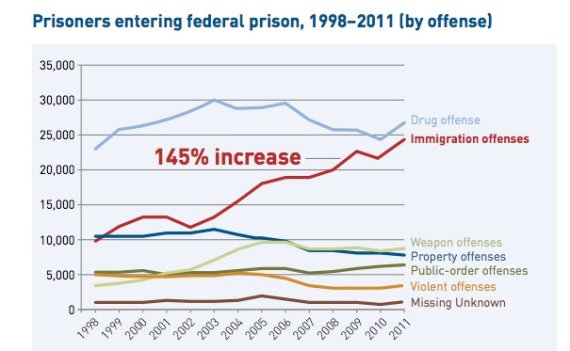
In recent years, the federal government's "Operation Streamline" policy offers "zero-tolerance" for undocumented immigrants. Under it, the number of non-citizens locked up in the U.S. has skyrocketed. Over 75 percent of those imprisoned have no criminal record.
federal
Source: ACLU Report: Warehoused And Forgotten: Immigrants Trapped in Our Shadow Private Prison System, 2014.
In 2009, more prisoners entered federal prisons for immigration violations than for violent offenses, weapon offenses and property offenses combined. Over half of non-citizen detainees, approximately 25,000 people, are living in privately owned facilities.
In private detention centers, detainees face physical abuse and mistreatment, including inadequate health care, threats of physical violence, overcrowding and conditions of squalor. There are sometimes arbitrary quotas for the solitary confinement units which are "reportedly kept so full that some people must sleep on the floor of a small cell they share with two strangers for 23 hours," according to the ACLU report. These facilities are geographically isolated, often far away from their families.
Many detainees lack the money to hire a lawyer and remain trapped in a seemingly endless legal process. As one detainee told the ACLU, "You lose your memory in this place. You keep counting days until you give up hope."
Meanwhile, private prison corporations found another way to profit off these people living in purgatory: They use detainees as cheap labor employing thousands to cook and clean the facilities. Some earn $1 a day; some earn candy bars, and some earn nothing. Last year, at least 60,000 detainees labored at these detention centers.


12. Private prisons try to cut costs by employing less-experienced staff and slashing prisoner resources.
Porter said private prisons make cuts that "compromise public safety, ranging from lower rates of pay, to not investing resources toward training, to reducing programs and rehabilitation efforts for prisoners." As a result, private prisons can have an assault rate double that of what is seen at publicly run prisons. And these facilities disproportionately hold young Americans: Nearly 40 percent of incarcerated juveniles will serve their time in private facilities, which have been plagued by physical and sexual abuse.
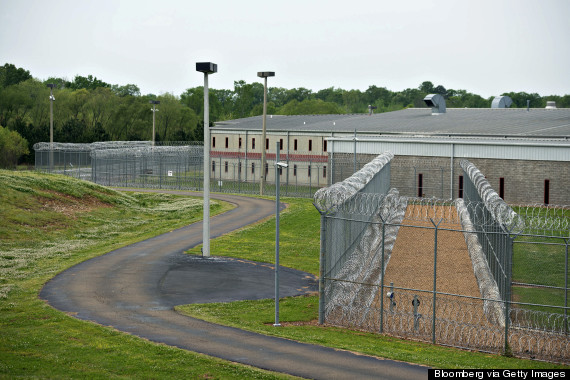
173314029
This is Walnut Grove Correctional Facility, a privately run juvenile detention center in Mississippi owned by GEO Group. A government investigation of the facility culminated in 2012, when a federal judge deemed it a "cesspool of unconstitutional and inhuman acts" withrampant physical and sexual abuse by the staff. Soon after, GEO Group shut down operations in Mississippi.


13. The system perpetuates a cycle of crime: More than two-thirds of people released from prison will be arrested again within three years.
That's according to a study by the Bureau of Justice Statistics. Among juveniles released, 70 to 80 percent will be arrested again within two to three years, according to a number of state studies. Contrary to what"tough on crime" politicians of the 80s and 90s once told voters, prison does not reduce crime and may actually produce future criminals.
While crime rates have declined over the past decades, don't thank our prison obsession. When Harvard Professor Bruce Western studied the decline in crime from 1993-2001, he found that just one-tenth of the decline was due to rising prison populations. The rest, he says, stemmed from factors like increased local police force presence.
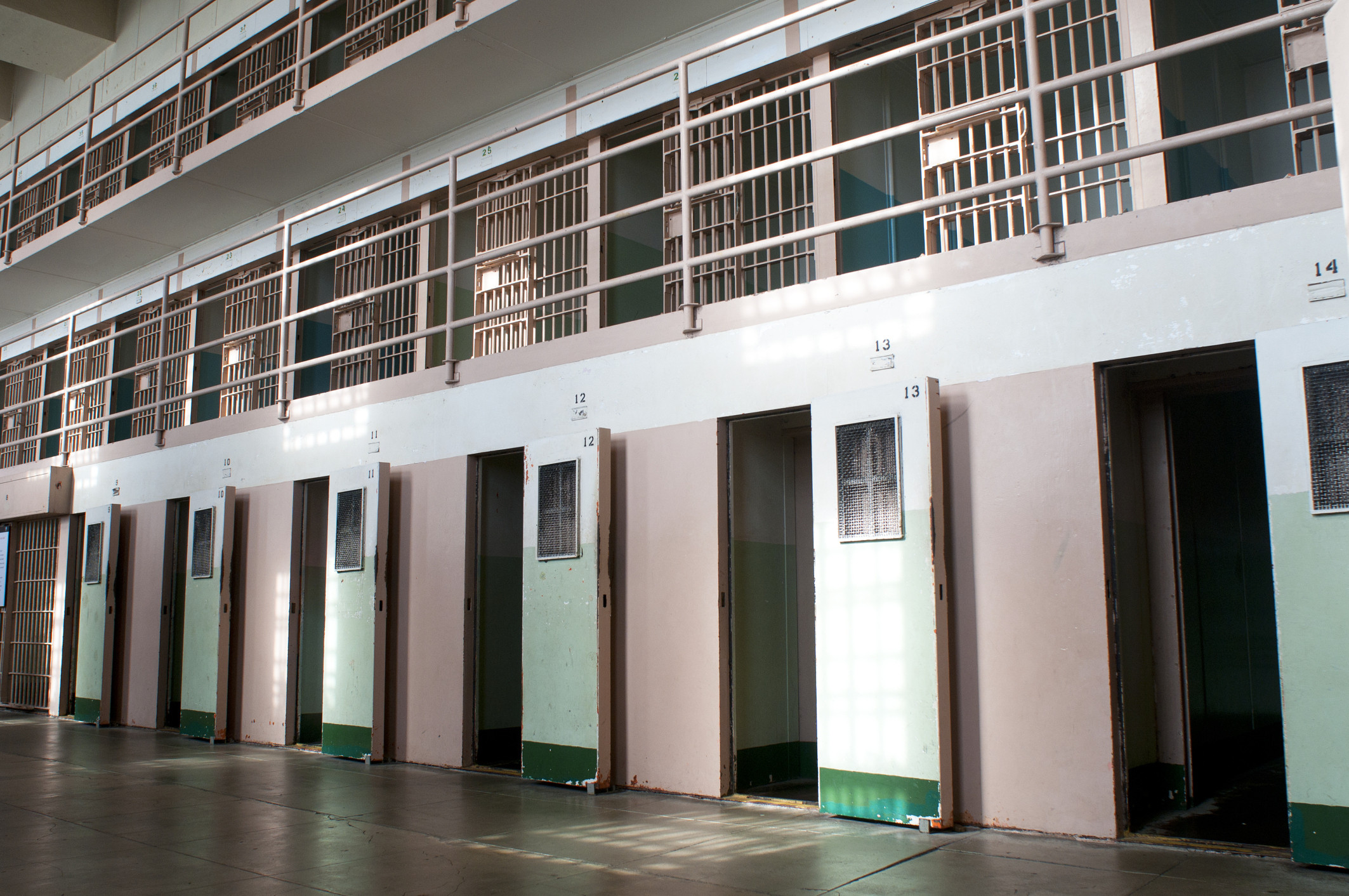
california prisons


14. It's become increasingly clear that we're more focused on locking people up than actually rehabilitatingthem.
As the Women's Prison Association President Georgia Lerner told the Guardian, this stigma lasts a lifetime. "We lock people up, strip them of all authority over themselves, disempower them in a very real way –- and then expect them to be able to function in the community after they are released," she said. "It simply doesn't work. Prisons were designed to confine people and keep them alive, and not much else."
Indeed, while more Americans are spending more time in prison, many lack access to drug education programs and mental health programs, both of which could help address the problems that got them locked up in the first place. And while a U.S. Department of Justice/RAND corporation joint study found that inmates given educational opportunities are 43 percent less likely to commit a future crime, only six percent of inmates were actuallyenrolled in such programs. Inmates with inadequate education face a daunting challenge of finding employment upon release, a challenge substantially magnified by the stigma of having a criminal record. It's not surprising, then, that former inmates face rampant unemployment and lower wages.
But released inmates face more than just the new financial burdens of the real world: Many leave prison with overwhelming debt due to legal fees. Though rules vary depending on the state, inmates can be charged for everything from court costs to public defender reimbursements, in-prison electricity bills, in-prison telephone bills, drug testing and parole supervision. In Texas, the average cost of being released on parole ranges from $500 to $2,000. Sometimes, the "crime" of not being able to pay off that debt lands former inmates back behind bars.
But Alabama, Georgia, and other Southern states have found a disturbing way to expedite that process: They allow former inmates to literally pay off their debt by spending more time in prison.
As the incomparable Stephen Colbert summed up this outrageous system in a recent segment, "Some may say that jailing people over their debts makes poverty into a crime. Well if that's true, maybe we should just cut out the middle man and put all poor people in jail. Of course, this will require new prison facilities, which we can build using people who can't pay their prison fees. Not as workers, as the bricks."

Private Prisons Contribute Thousands To Oklahoma Political Campaigns


ulsa World  |  By Curtis Killman and Cary AspinwallPosted:   |  Updated: 03/08/2014 5:59 am EST
The role of private facilities under a new state prison reform law was among the concerns that led to the quashing of parts of the law, documents released by Gov. Mary Fallin's office show.
Operators of private prisons in Oklahoma angled for a slice of the prison reform pie, campaigning to have their halfway houses serve as the "intermediate sanctions facilities" spelled out in the new law to handle low-level offenders who violated terms of their release.
Leaders from Avalon Correctional Services and GEO both sought meetings with the Governor's Office and DOC officials regarding the Justice Reinvestment Initiative reforms, records show.
Private corrections and their supporters hand out a lot of campaign donations in Oklahoma politics. Since 2004, private corrections interests and those who represent them have spent more than $400,000 to fund various elected officials' campaigns and political causes, a Tulsa World analysis of Ethics Commission disclosure reports shows.
The amount spent includes $50,750 in contributions for incumbents' 2014 re-election campaigns, the analysis shows.
The $414,397 total spent ranges from a few bucks spent by lobbyists whose clients include a private corrections company to thousands spent to fund political events such as the Oklahoma Speaker's Ball.
Three private corrections companies with operations in the state -- Corrections Corporation of America, The Geo Group, Inc. and Avalon Correctional Services Inc. -- are the primary donors to political campaigns in Oklahoma.
An April 2012 email from a private prison lobbyist shows he sought a meeting with the governor on behalf of GEO President John Hurley and other executives.
"We would like to hear your thoughts on JRI and future impact on corrections," lobbyist Brett Robinson wrote.
That email is among more than 8,000 documents released by Fallin's office in response to Open Records requests regarding Oklahoma's stalled prison reform laws enacted in 2012 under House Bill 3052. The records also show an internal document from Fallin's office that listed a "possible concern" of HB 3052:
"Excludes private facilities," the email notes.
In March 2013, Avalon Chief Operating Officer Brian Costello sent Fallin's staff an email outlining his company's campaign to house the inmates sent to intermediate sanctions facilities under the prison reform law, something they began requesting in 2011.
Fallin's campaign committee is the top recipient of corporate corrections funding, receiving $38,250, through Sept. 30, records show.
Political action committees representing two private corrections companies with interests in the state have donated the maximum allowed, $5,000, to Fallin's 2010 and 2014 campaign committees.
A Fallin campaign spokeswoman said in an email that the donations represent less than half a percent of nearly $11 million raised by Fallin since 2002.
"The $10.9 million raised from the 2002 campaign to the present are donations received from hardworking Oklahomans of every background who have supported Mary Fallin. ... Pick any industry and odds are it will have donated the most to Mary Fallin simply because she has been around the longest and run and won more campaigns than her current peers at the Capitol."
House Speaker T.W. Shannon ranks No. 2 in corporate corrections donations, with a combined $35,950 contributed to his campaign committee and a fund that finances the Oklahoma Speaker's Ball.
The three private prison companies donated between $5,000 and $10,000 in late 2012 and early 2013 to the Oklahoma Speaker's Ball, Inc., the committee that finances the annual event.
Up-to-date contributions to the 2014 Speaker's Ball were not available as political action committees have until Jan. 31 to file timely disclosure reports reflecting fourth quarter 2013 transactions.
The 2014 Speaker's Ball is scheduled for Jan. 31 in Norman.
Joe Griffin, Shannon's communications director, said in an email: "A majority of the donation funds from this industry (roughly $22,500) were donated toward a nonprofit to encourage the mentoring of our youth through the Speaker's Ball. ... People and entities donate to campaigns because they believe in the candidate's ideals -- not because the candidate necessarily believes in theirs."
Republican state Sen. Clark Jolley ranks third among active, elected officials in private prison donations, receiving $29,301.
Jolley said Avalon Correctional Services and its CEO are located in his district and have been constituents for some time. The company is concerned about the way private prison companies have been treated during the past several years, especially regarding halfway houses, he said.
"I suspect that a good part is reflected because of that," Jolley said.
Overall, Avalon Correctional Services leads the three corrections companies in political spending, contributing $156,085 to political campaigns and related interests since 2004.
The Geo Group Inc. was close behind, donating $143,411 to political committees.
Lobbyists who represented both Avalon Correctional Services and Corrections Corporation of America at the same time donated $63,450 to political campaigns. CCA employees and lobbyists hired by the Nashville-based company donated another $51,000 to various political causes.
Prison companies have donated $17,500 to state Treasurer Ken Miller's campaigns, $14,500 to Lt. Gov. Todd Lamb and $12,250 to Insurance Commissioner John Doak, all Republicans.
Former gubernatorial candidate Jari Askins led Democratic Party recipients with $11,150 in receipts for her political campaigns. Lobbyists provided about $136,497 in funding with the balance, about $278,000, coming directly from employees of prison companies or their PACs.
Top actively serving recipients of private prison contributions
Gov. Mary Fallin $38,250
House Speaker T.W. Shannon $35,950*
Sen. Clark Jolley $29,301
Treasurer Ken Miller $17,500
Lt. Gov. Todd Lamb $14,500
Insurance Commissioner John Doak $12,250
Sen. Rob Johnson $11,250
Sen. Don Barrington $9,635
Sen. Dan Newberry $8,750
Rep. Todd Thomsen $8,400
*Includes $22,500 to Oklahoma Speaker's Ball, Inc.(Contributions 2004 through Sept. 30, 2013)Source: Tulsa World analysis of state campaign contribution data.
World Capitol Bureau Reporter Barbara Hoberock contributed to this story.
Curtis Killman 918-581-8471
Cary Aspinwall 918-581-8477